
If your website looks beautiful but doesn’t rank — or ranks but doesn’t convert — you don’t have a traffic problem. You have an alignment problem.
At Burnesseo, we see this across South African businesses every week. Companies invest in web design or SEO in isolation, hoping one will fix the other. But effective seo doesn’t happen in silos. It happens when your seo content strategy, website design, and user experience work together as one cohesive system.
As a results-driven studio offering advanced seo and digital marketing services, we believe that creating an effective seo strategy means ensuring that your content, structure, and technical performance all move toward the same business objective.
This guide will show you exactly how to build a powerful seo content plan that aligns with your website design and UX strategy — so you can attract the right traffic, keep visitors engaged, and convert them into real leads.

Why SEO and UX Must Work Together
Many businesses still treat seo and design as separate departments. But search engines like Google reward websites that deliver a better content experience.
A successful seo strategy involves:
- Strong keyword research
- Clear site architecture
- Optimised on-page seo
- Seamless navigation
- Fast load speeds
- Valuable, engaging content
When these elements align, search engines understand your content more easily, and users trust your brand faster.
Without a strategy that integrates both, even the best content may struggle to rank or convert.
Step 1: Define Clear SEO Goals Before You Create Content
Before you create an seo content strategy, you must define measurable seo goals.
Ask:
- Are we targeting local South African searches?
- Do we want more qualified leads?
- Are we building authority in a specific niche?
- Do we want to build your seo presence nationally or internationally?
Your seo strategy for a business should connect directly to revenue — not just traffic. That’s where developing a strategy rooted in business outcomes becomes critical.
We always start with clarity around:
- Target audience
- Buyer intent
- Competitive landscape
- Conversion pathways
Because content that aligns with business objectives performs better long-term.
Step 2: Structure Your Website to Support Content for SEO
Your website design should shape the content, not fight against it.
A clear structure helps search engines like Google crawl your site and improves how visitors navigate the body of content.
Here’s what strong alignment looks like:
✔ Logical Site Architecture
Organize your content into:
- Core service pages
- Supporting blog categories
- Topic clusters
- Internal linking paths
This ensures that your content aligns with your primary offerings.
✔ UX-Driven Layout
Good UX means:
- Clean navigation
- Clear headings
- Mobile responsiveness
- Strong calls to action
- Readable formatting
Even high-quality content can fail if it’s buried in a cluttered design.
✔ Technical SEO Foundation
Technical seo plays a crucial role in content visibility. Your site should:
- Load quickly
- Be mobile-friendly
- Have proper schema markup
- Avoid duplicate content
- Use clean URLs
When it comes to seo, the backend matters just as much as the actual content.

Step 3: Conduct Strategic Keyword Research
Every piece of content should serve a search purpose.
Use a tool like:
- SEMrush
- Ahrefs
- Google Keyword Planner
Combine that with insights from Google Search Console and Google Analytics to identify:
- What users are already finding you for
- Where you’re missing opportunities
- Which search result pages are you close to ranking on
This is where content planning becomes data-driven rather than guesswork.
Remember: SEO is not about chasing volume. It’s about relevance and intent.
Step 4: Develop a Content Strategy That Supports UX
Your content strategy should reflect how users consume information.
Ask:
- Do they prefer long-form guides?
- Do they want quick answers?
- Is visual content important?
- Are FAQs driving traffic?
Different types of content serve different roles in content marketing:
- Blog posts
- Landing pages
- Service pages
- Case studies
- Infographics
- Video
A strong approach to content means designing content topics around user journeys.
For example:
- Awareness stage → Educational content to help
- Consideration stage → Comparison guides
- Decision stage → Case studies and testimonials
This ensures that your content marketing efforts guide users naturally through your funnel.
Step 5: Create a Content Calendar Around Business Priorities
A content calendar around strategic themes ensures consistency.
Include:
- Monthly focus keywords
- Publishing dates
- Internal linking targets
- Promotion channels
- Performance tracking metrics
Creating new content without structure leads to fragmentation.
With a structured content creation process, your content team knows:
- What to write content about
- Why it matters
- How does it support the bigger marketing strategy?
Step 6: Design Pages That Help Search Engines Understand Your Content
Good UX helps users. Smart formatting helps search engines understand your content.
Use:
- Clear H1, H2, H3 hierarchy
- Bullet lists
- Short paragraphs
- Structured data
- Internal linking
- Optimised meta descriptions
This ensures that your content is performing well both for humans and algorithms.
Remember, search engines like Google scan before they rank. Structure helps them interpret your content for search more accurately.
Step 7: Align Content Production with Conversion Strategy
Content can take many forms, but it must serve a purpose.
Your seo content strategy should ensure:
- One piece of content targets one primary intent
- CTAs are placed naturally
- Landing pages match user expectations
- Design supports readability
If users land on a page that doesn’t match their Google search intent, they leave — and rankings drop.
Make the content match the promise of the headline.
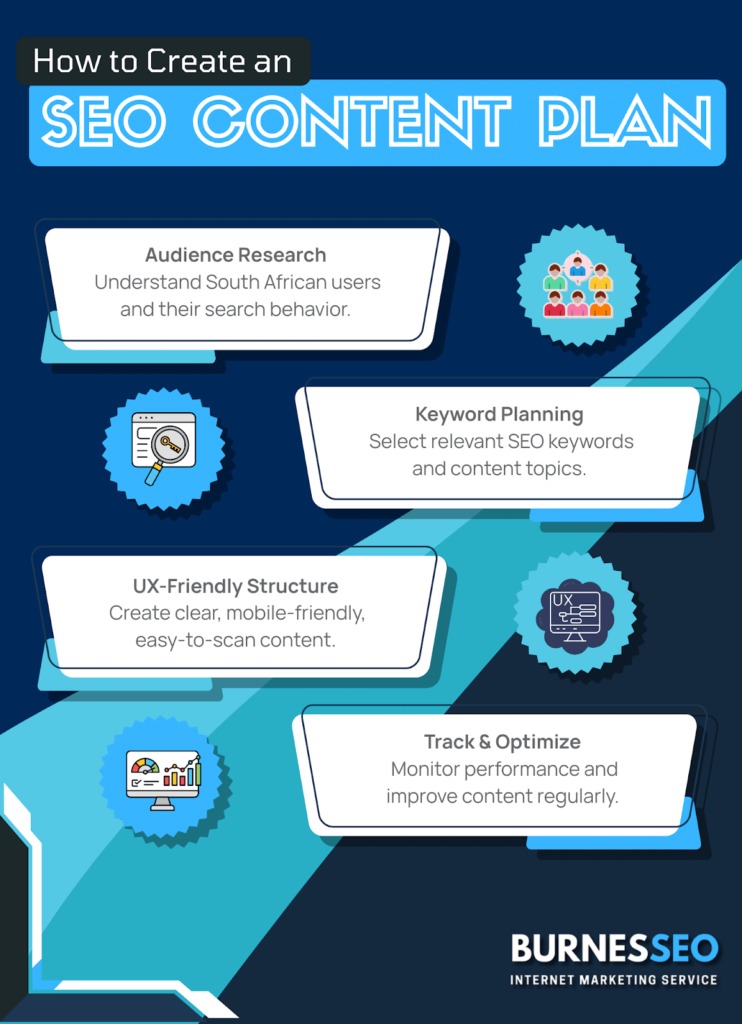
The Modern Content Creation Workflow
Best Fit: Who This Is Ideal For
This approach is ideal for:
- Growing South African SMEs
- E-commerce businesses
- Professional service providers
- B2B companies
- Businesses investing in digital marketing long-term
If you want content that works — not just content that’s published — alignment is non-negotiable.
Common Mistakes to Avoid
❌ Creating Content Without a Strategy
Without a strategy, content may compete internally or miss search demand entirely.
❌ Ignoring UX in SEO Strategy
A poor layout damages trust and conversion.
❌ Focusing Only on Rankings
Traffic without conversion drains marketing efforts.
❌ Publishing and Forgetting
You must refine your strategy based on how your content is performing.
Measuring Performance of Your Content
Track:
- Organic traffic growth
- Bounce rate
- Conversion rate
- Engagement metrics
- Keyword improvements
Use a tool like Google Analytics and Google Search Console to evaluate:
- Which part of the content drives engagement
- Whether content that directly targets buyer intent converts
- Where content optimization is needed
Creating an effective seo strategy is iterative.
Why Choose Burnesseo?
We’re not just another agency selling seo packages.
Here’s what sets us apart:
- We integrate seo and content with UX design.
- We focus on measurable ROI, not vanity metrics.
- We build long-term authority, not quick wins.
- We combine technical seo with compelling content production.
- We customise every seo strategy for a business.
You can explore our background on our About page, review proven results in our case studies, and see how our seo strategies consistently deliver sustainable growth.
Unlike many competitors who focus purely on ranking metrics, our digital marketing strategy ensures that your content management system, UX, and conversion pathways are aligned from day one.
Competitor Comparison (Neutral Perspective)
Many agencies:
- Offer generic packages
- Outsource content creation
- Focus only on backlinks
- Ignore UX design
A successful seo strategy, however, requires integration.
We believe creating a content ecosystem — not isolated blog posts — ensures that your content aligns with user behaviour and search demand.
FAQs
How do I create seo content that aligns with UX?
Start by mapping keywords to user intent, structure pages clearly, and ensure the design supports readability and navigation.
How often should I publish content?
Quality matters more than frequency. Focus on high-quality content that supports your seo goals.
What role does technical seo play?
Technical seo ensures search engines understand your content and index it properly.
Can content alone improve rankings?
Content is critical, but even the best content needs structure, optimisation, and UX support.
How do I know if my content is performing?
Track organic traffic, keyword movement, engagement metrics, and conversions using analytics tools.
Final Thoughts: Alignment Is the Real Competitive Advantage
SEO and content are no longer optional — but random publishing won’t deliver results.
When you learn how to create a structured, UX-aligned seo content strategy, you build more than traffic. You build authority, trust, and predictable lead generation.
If you’re ready to create an effective, integrated approach to content for seo that supports long-term growth, our team at Burnesseo is here to help. Let’s build a smarter foundation for your digital visibility — and turn your website into your strongest sales asset.