From Installer to Industry Voice.
A behind-the-scenes look at what we’ve built for Designer Pool Covers — the full-stack strategy that turned a single installer into the brand South Africa thinks of first when it hears “pool safety.”

The client
Designer Pool Covers design, manufacture and install custom pool cover systems across Johannesburg, Durban and Cape Town — 4,500+ installations and counting. Our job: make them the brand South Africa thinks of first when it hears “pool safety.”
They’ve been a BurnesSEO client for seven years — SEO, social media, press and, more recently, GEO. In that time they’ve grown from a single branch to three, and now service the whole of South Africa. Here is the full-stack over the last few months.
SEO and website

Internal SEO action plan plus a WordPress SEO implementation playbook for designercovers.co.za — built to keep the site ranking as fast as the install calendar fills up.
Site content built around what buyers actually search: safety covers, thermal blankets, automatic covers. The queries we prioritised tell the whole story: “automatic pool covers price south africa”, “rigid pool cover systems”, “thermal pool cover”, “polycarbonate pool cover”, “designer pool covers cape town.” Small numbers — some get searched a few hundred times a month. But every one is typed by someone specifying a R50,000+ purchase, not someone pricing a R2,000 bubble blanket.
That qualification shows in the click-through rates: 13.3% on price queries, 50% on the most specific product terms, 8.6% on location terms. When your market is narrow and premium, who finds you matters infinitely more than how many.
Over seven years we built a library answering the questions premium buyers actually ask: how long covers last, whether a pool heats faster covered or uncovered, manual vs automatic systems, ROI on a quality cover, safety and pets. These pages rank on page one and do something no advert can — they make Designer Pool Covers the educator in the category.
Press and media
National outreach campaign across 98 local newspapers in all 9 provinces — not a single province missed.
SANS 10134 safety press release ahead of the high-risk summer window (450+ child drownings a year in South Africa) — positioning the brand as the compliance voice, not just a seller. This is the kind of coverage that builds authority with both journalists and AI assistants: a real safety standard, a real statistic, a real brand name attached.
Caxton media proposals reviewed for paid amplification to extend reach beyond organic pickup.
Social media

A consistent content engine — 258 posts in the first half of 2026, a +186.67% increase in output over the prior half.
- Instagram: “Are You Spring Ready?” campaign plus a premium, safety-first brand awareness series
- Facebook: 8-static winter campaign selling heat retention and pet-and-child safety for Joburg homes
- On-trend creative, including Bafana Bafana World Cup support content
SEO got them found; consistent social media kept them believed. Years of completed-project showcases, real installations and customer interactions built the kind of online sentiment money can’t shortcut.
YouTube
Integrated YouTube Studio analytics and turned the channel into a real growth platform.
Produced the “Prep Starts Now” spring prep video brief — turning seasonal pool maintenance into brand content that works year-round in search and on social.
Analytics and reporting
Half-year performance audit with a positive-focused executive deck on visibility and growth — the kind of reporting that shows a client exactly where the investment is landing.
GEO: being the answer, not just the result
As AI search grew, we restructured their content so ChatGPT, Gemini, Perplexity and the other AI assistants can parse it, trust it and cite it: direct-answer sections, comparison formats, clear product attributes, consistent facts everywhere the brand is mentioned online. The principle is simple — AI tools recommend the brands they can verify. We made Designer Pool Covers the most verifiable brand in their category. That is the discipline behind our Generative Engine Optimisation work.
And here’s the thing about all that social media and press work most agencies won’t tell you: it’s now measurable in AI search. When we track how AI assistants talk about this brand, the sentiment score is 100% positive. Zero negative. Seven years of doing things properly, showing up in a number.
The GEO results, measured
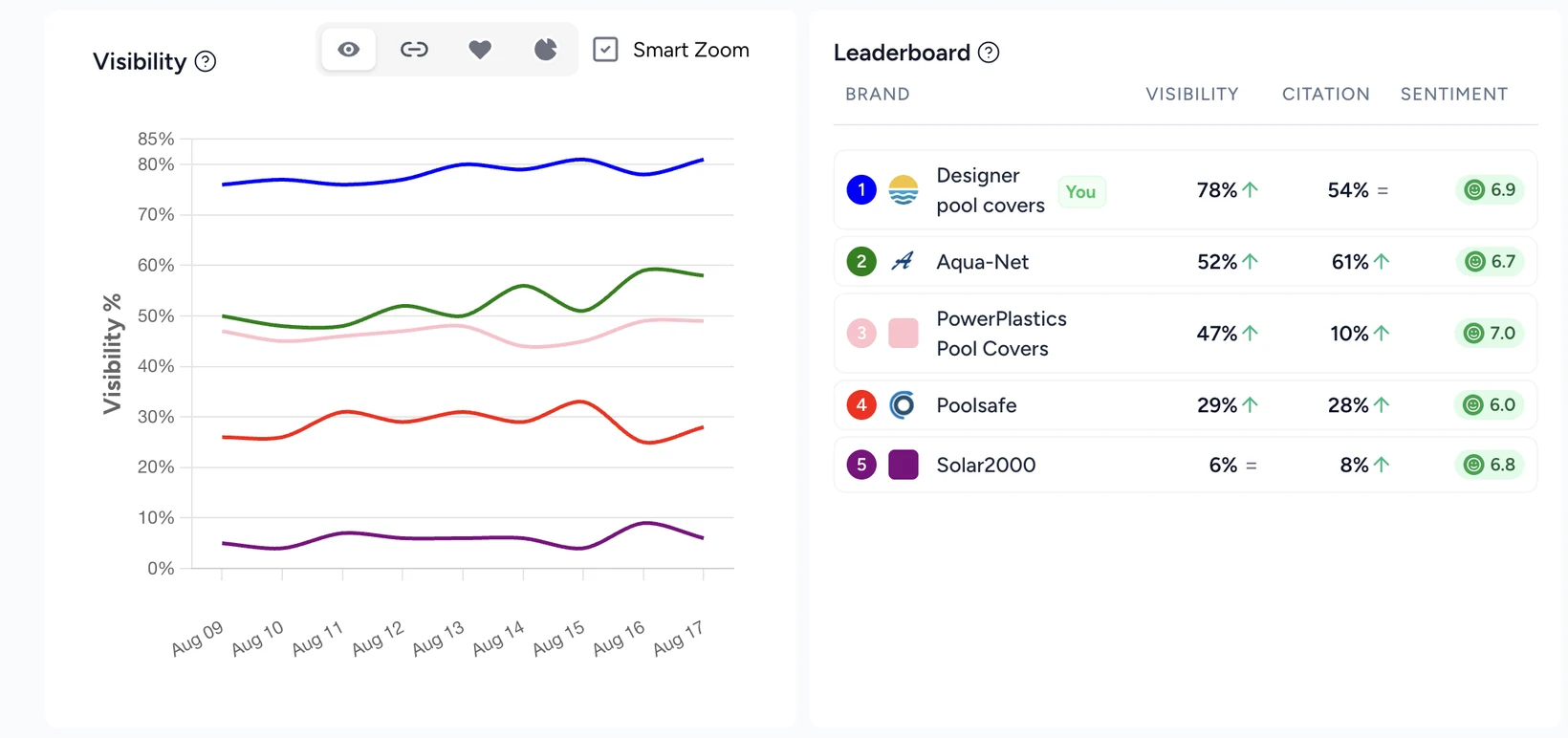
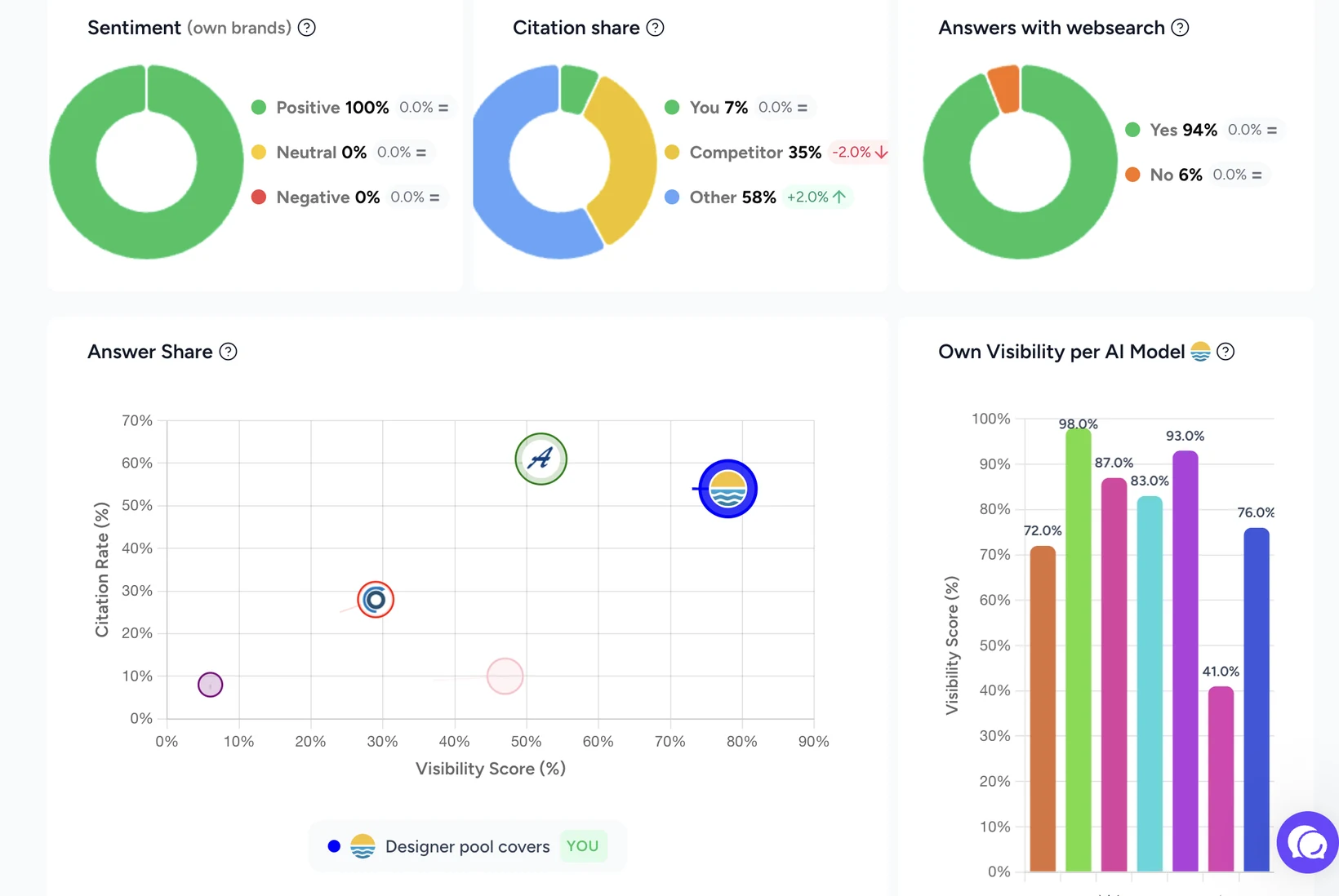
Anyone can say “we do GEO.” Here’s what it looks like when you actually track it. We monitor how the major AI assistants answer pool-cover buying questions — who they mention, who they cite, and what they say — across a tracked set of category queries:
| AI-search metric | Designer Pool Covers | Nearest competitor |
|---|---|---|
| AI visibility score | 78% — #1 of 5 brands tracked | 52% |
| Citation rate | 54% | 61% |
| Sentiment in AI answers | 100% positive / 0% negative | — |
| Visibility across seven major AI models | 72%, 76%, 83%, 87%, 93%, 98% (and 41% on the newest entrant) | — |
Three things worth being honest about in those numbers, because honest is the whole point:
- The lead is real and consistent. Across the tracking period, their visibility never dropped out of the 75–82% band and never lost first place. This isn’t a screenshot of a good day.
- One competitor cites slightly better. A rival’s citation rate sits at 61% to our client’s 54% — while being visible only 52% of the time. That’s the difference between being mentioned and being trusted as a source, and it’s exactly the gap the next phase of work targets. We’d rather show you a real number with work left in it than a rounded-up story.
- 94% of these AI answers pull from live web search. Which means the content on your website right now — its structure, its facts, its clarity — is what decides whether AI tools recommend you. GEO isn’t a bolt-on. It’s what your SEO becomes.
The numbers
| Metric | Result |
|---|---|
| Installations | 4,500+ and counting |
| Branches | Three — Johannesburg, Durban, Cape Town (up from one) |
| Social posts, H1 2026 | 258 (+186.67% output growth) |
| Press coverage | 98 local newspapers, 9 provinces |
| AI visibility score | 78% — #1 of 5 brands tracked |
| AI sentiment | 100% positive, 0% negative |
| Google position (category identity) | Average 1.4 |
| Price-intent CTR | 13.3% |
| International reach | US, UK, Germany, Canada |
| Then | Now | |
|---|---|---|
| Footprint | One branch | Three branches, national coverage |
| Lead source | Reputation-driven referrals | Referrals plus a search presence that qualifies buyers before they call |
| Search presence | Invisible beyond brand name | Average position 1.4 on their category identity term; top 3–7 on premium price, product and location terms |
| AI search | Unknown to AI assistants | #1 AI visibility in their category (78%), 100% positive sentiment |
| Brand perception | Local installer | Industry voice — the brand media and AI cite on pool safety |
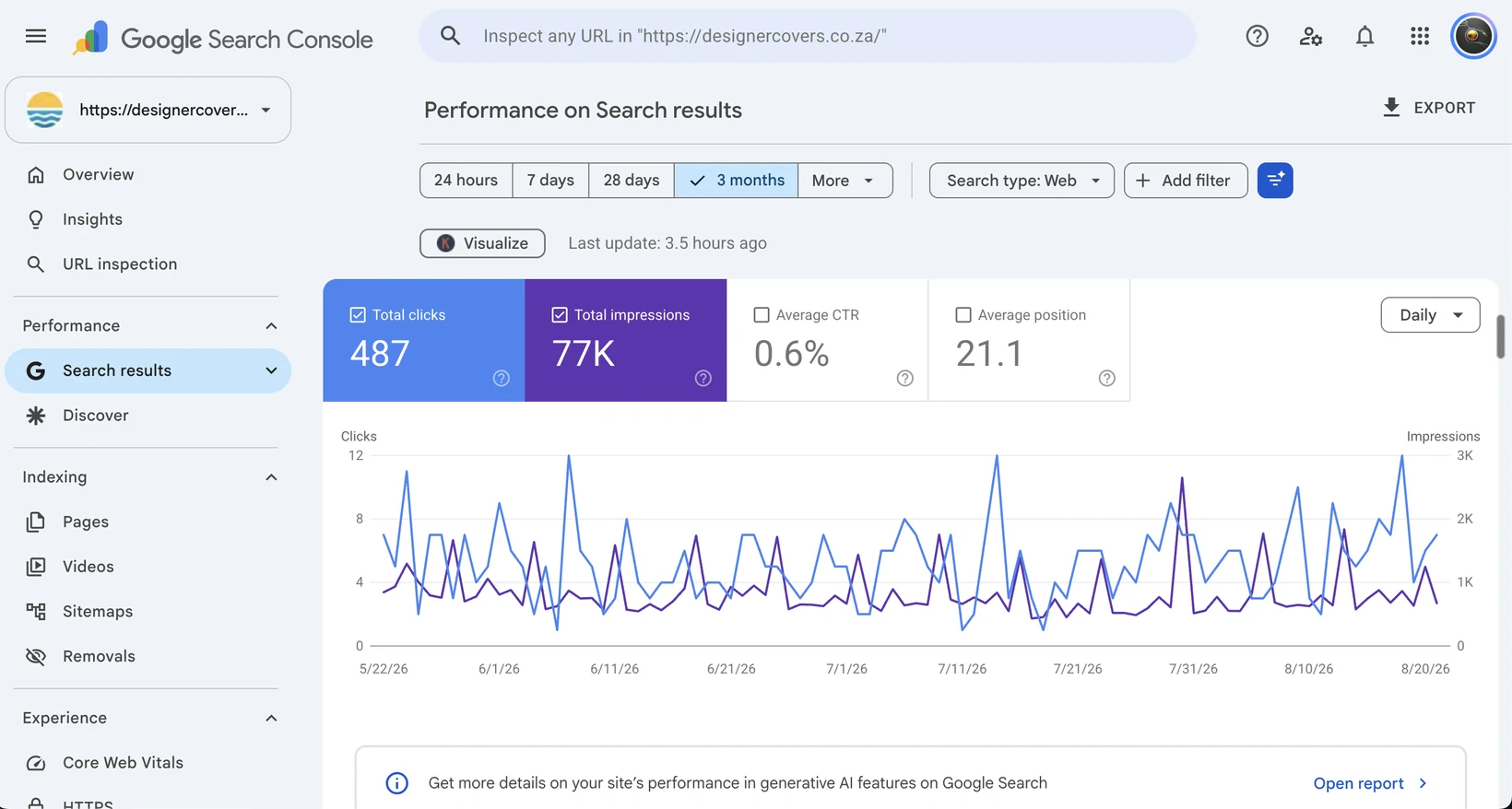
The average Google position across all queries sits around 21 — and we’ll be honest about why: broad, high-volume terms like “pool covers” pull that average down, and those are terms this client consciously doesn’t chase. That’s not a gap in the strategy. That is the strategy.
What this means if your business sells premium
Three honest lessons from seven years on this account:
- Volume is a vanity metric in a premium market. Fifty qualified searches beat five thousand browsers. If your average sale is high-value, rank for the searches that signal budget — price, specification, comparison, location.
- Building a brand takes more than posts. It takes a system. SEO, press, social, video and AI search all feeding each other — that’s what turns an installer into an industry voice. No single channel did this on its own.
- SEO compounds like reputation — because it is one. Seven years of consistent work is why three branches, national coverage and a 100% positive AI sentiment score were possible. There’s no shortcut version of that, and anyone selling one is selling something.
Building a brand takes more than posts. It takes a system.
If you sell a premium product or service and your instinct is “we don’t need everyone to find us, just the right people” — that’s a strategy we know how to run, and have run for seven years, on Google, in AI search, in press and across social.
Check how visible your business is in AI search with our AI Visibility Score — the same style of measurement behind the numbers in this case study — run our free 30-second website audit, or book a chat. First month is free — and if SEO isn’t the right spend for you right now, we’ll tell you that too.
For the other end of the market — high-volume e-commerce — see how we grew an online store from 10,000 to 1.24 million impressions. Same discipline, very different playbook. And if you want the numbers behind our pricing, read what SEO costs in South Africa.






Building a brand takes more than posts. It takes a system.
Want the same for your business? First month is free on Starter, Growth and Scale — and if SEO isn’t the right spend for you right now, we’ll tell you that too.