Case Study: Three Years, Every Branch on Page One — SEO for Isilumko Staffing
How a South African staffing agency turned Google into its hardest-working branch — for employers and job seekers alike.

The short version
Isilumko Staffing has been a BurnesSEO client for three years. Staffing is a two-sided market — every month they need to be found by employers looking for staff and job seekers looking for work. Search had to serve both.
Three years in, the last 90 days look like this:
- 12,900 organic clicks — roughly 140 visits a day, no ad spend
- 7.5% click-through rate — exceptional at their average position, because a huge share of searchers are looking for Isilumko by name
- #1–#3 for every brand and branch term — "isilumko staffing", "isilumko vacancies", "isilumko staffing brackenfell", "isilumko midrand", "isilumko staffing vacancies in durban" — each branch wins its own city
- Search as a service channel: "isilumko staffing upload cv" (334 clicks), "isilumko online application", "isilumko whatsapp number" — candidates aren’t just finding them on Google, they’re applying through it
- Mobile dominance: 10,867 clicks on mobile at a 12.5% CTR — where job seekers actually live
- A content library ranking on page one for the questions both employers and candidates ask — from "using online job boards" to "data privacy in recruitment"
Where they started
Staffing might be the most competitive local SEO category in South Africa. Every city has dozens of agencies, job boards dominate the generic searches, and the big national players have budgets a growing agency can’t match head-on.
Isilumko had the fundamentals — real branches, real placements, a growing reputation — but three years ago their search presence didn’t reflect any of it. Candidates who’d heard the name couldn’t always find the right page. Employers researching agencies found competitors first. And each branch was invisible in its own city.
The strategy we set was built around how staffing actually works: win the brand and the branch, serve the job seeker’s intent completely, and build employer-facing authority through content.
What we did
Own the brand — all of it
Brand searches are the highest-intent traffic a staffing agency gets: someone typing "isilumko staffing vacancies" is ready to apply today. We made sure every variation resolves perfectly — the name, the misspellings ("silumko", "islumko" — both rank #1), and every brand-plus-intent combination: vacancies, upload CV, online application, contact details. Today those queries sit at #1.7 to #2.9 with click-through rates between 12% and 35%. When someone looks for Isilumko, Isilumko is what they find.
Every branch, its own city

A national footprint only works online if each branch is findable locally. We built and optimised location-level presence so that "isilumko staffing brackenfell", "isilumko staffing midrand", "isilumko umhlanga" and their siblings all rank top four — candidates find their branch, and employers see a genuinely national operation. Even the street address ("69 london circle brackenfell") ranks.
Serve the job seeker’s full intent
Here’s what most agency websites miss: the job seeker’s journey doesn’t end at the homepage. They need to upload a CV, find vacancies, apply online, get a contact number. We structured the site so those service queries land on working pages — and Google noticed. Today, hundreds of candidates a month arrive already mid-application. That’s not marketing traffic; that’s operations running through search.
Content for both sides of the table
For candidates: how to use online job boards, how learnerships work, how to check work eligibility. For employers: how to measure ROI on recruitment, screening applicants, avoiding discrimination in hiring, data privacy in recruitment. Both libraries rank — and the employer-facing content does quiet sales work, positioning Isilumko as the professional choice before a sales conversation ever starts.
Mobile-first, because job seekers are

84% of clicks come from mobile, converting at 12.5%. Every optimisation decision — speed, layout, application flows — was made for a candidate on a phone in a taxi, not a desktop in an office.
The results, in their own data
From Google Search Console, last 90 days:
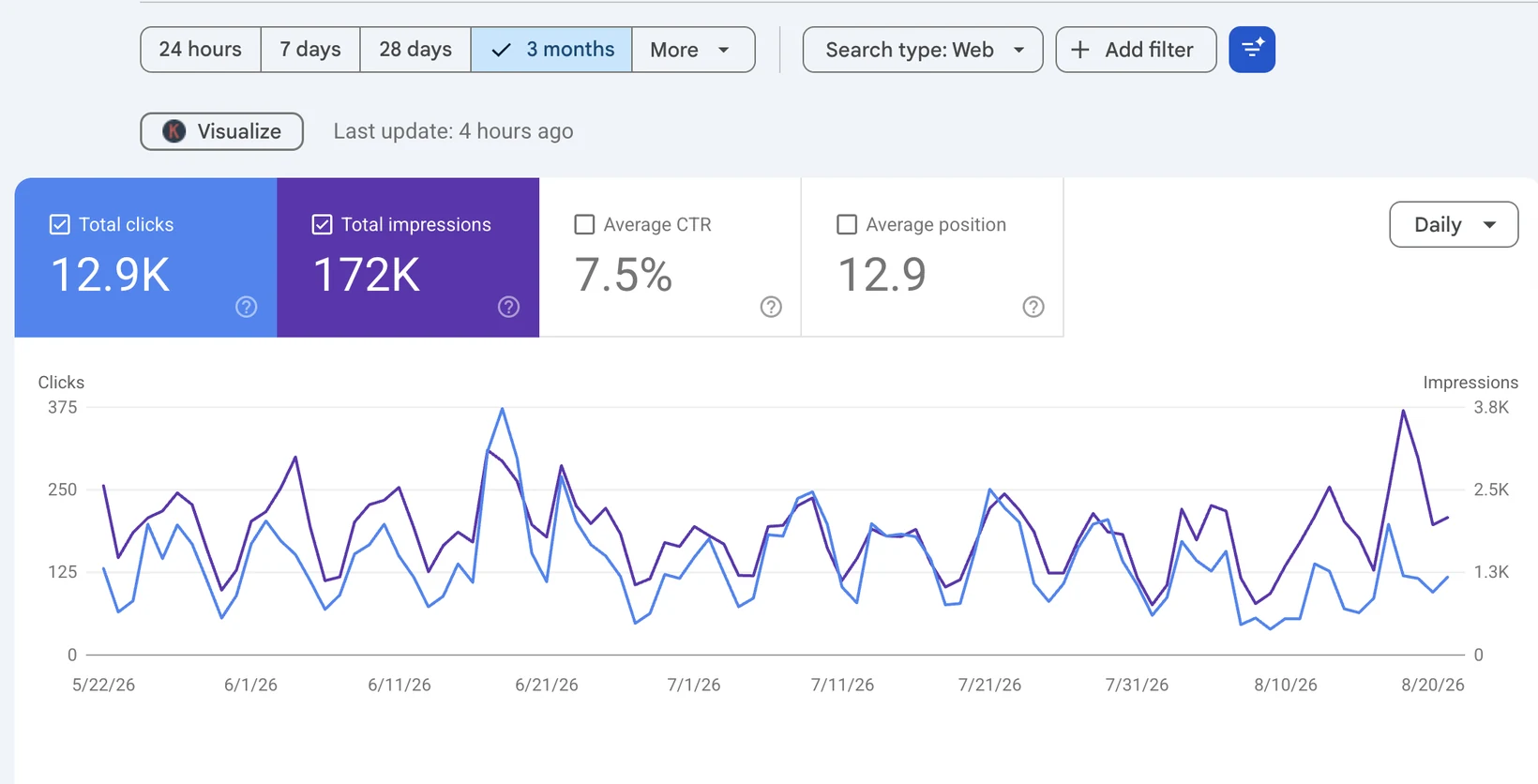
| Metric | Result |
|---|---|
| Organic clicks | 12,900 (~140/day) |
| Impressions | 172,000 |
| Click-through rate | 7.5% |
| Brand queries | #1.7–#2.9, CTR up to 35.6% |
| Branch/location queries | Top 4 across Brackenfell, Midrand, Cape Town, Durban, Umhlanga, PE, Bloemfontein |
| Candidate service queries ("upload cv", "online application") | Page one, hundreds of clicks monthly |
| Mobile share | 84% of clicks at 12.5% CTR |
| Core commercial pages | Homepage + staffing page: 10,500+ clicks combined |
One honest number: average position across all queries is 12.9 — pulled down by broad industry terms like "recruitment agency" where job boards and nationals dominate. We could chase those and triple the impressions. But impressions don’t place candidates — the brand, branch and service terms do, and those are exactly where Isilumko wins.
What this means if you run a service business
Three honest lessons from three years on this account:
- Brand search is an asset you build, not a given. "People can just Google our name" is a strategy only if every variation — misspellings, brand-plus-service, brand-plus-city — actually resolves. Most businesses leak 20% of their own brand traffic. Isilumko doesn’t.
- Search can run your intake, not just your marketing. When "upload cv" and "online application" queries rank and convert, Google becomes an operational channel. For service businesses, that means your website working like an extra branch — one that never closes.
- In two-sided markets, content is your credibility. Employers don’t pick an agency from an ad; they pick the one whose thinking they’ve already read. Ranking for the questions your clients ask is the longest, warmest sales pitch there is.
Could this work for your business?
If you run a service business — staffing, legal, medical, trades, anything where trust decides the enquiry — this is the playbook: own your name, win your locations, serve the full intent, and let content do the selling.
Run our free 30-second website audit, check your AI Visibility Score, or book a chat. First month is free — and if SEO isn’t the right spend for you right now, we’ll tell you that too.
For a very different market, see how we grew an online store from 10,000 to 1.24 million impressions, or how a pool cover installer became the industry voice. Same discipline, three different playbooks. And if you want the numbers behind our pricing, read what SEO costs in South Africa.






Could this work for your business?
If you run a service business — staffing, legal, medical, trades, anything where trust decides the enquiry — this is the playbook: own your name, win your locations, serve the full intent, and let content do the selling. First month is free, and if SEO isn’t the right spend for you right now, we’ll tell you that too.