SEO vs AEO vs GEO: What South African Businesses Actually Need in 2026
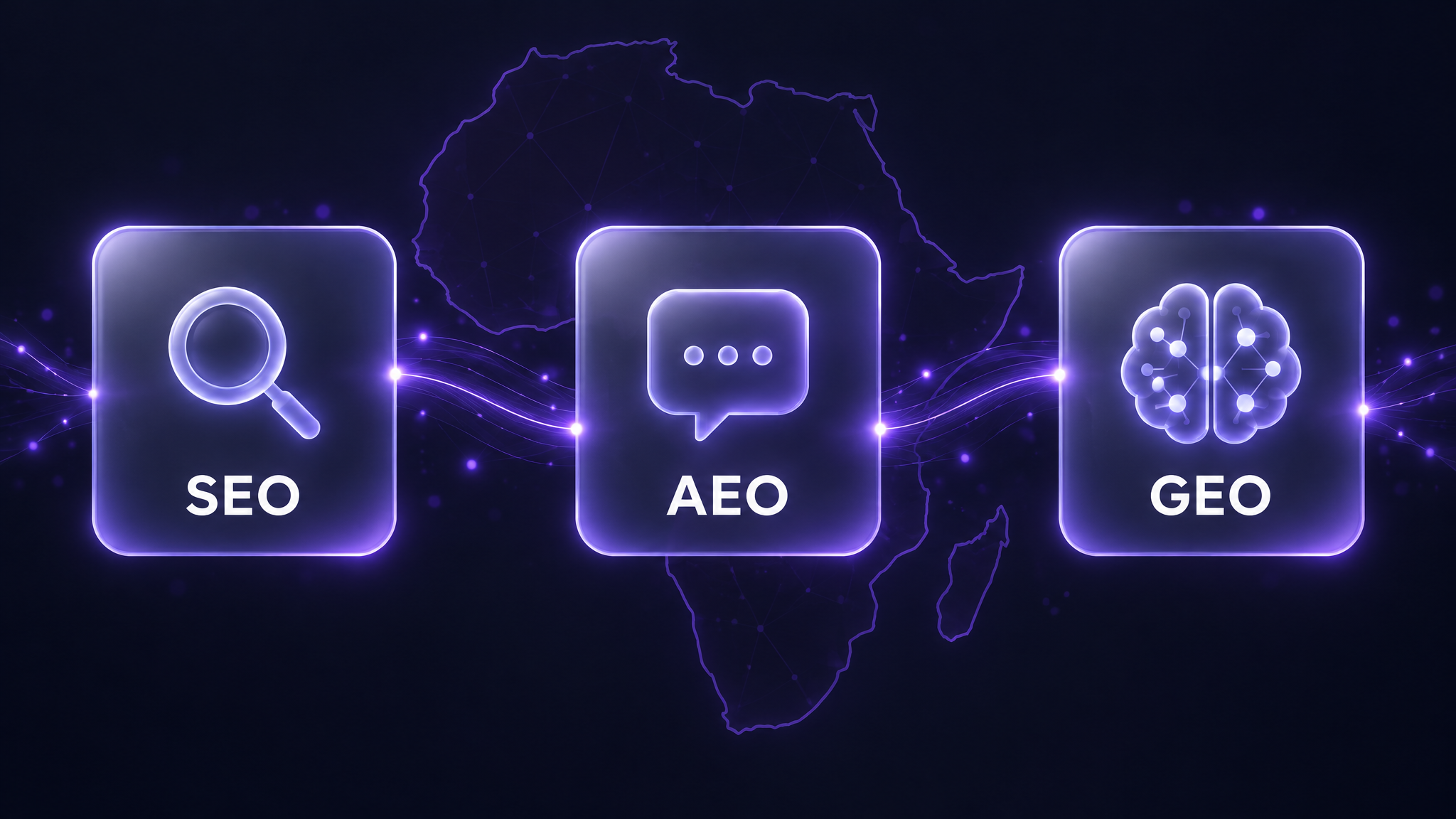
Three acronyms are competing for your marketing budget in 2026: SEO, AEO and GEO. They are not the same thing, they do not replace each other, and the order in which you tackle them matters. This guide explains what each one does, how they differ, which South African businesses need first, and how to build all three without wasting money on the wrong one.
| SEO | AEO | GEO | |
|---|---|---|---|
| Goal | Rank in links | Win direct answer | Be named by AI |
| Shows up in | Google organic | Snippets, AI Overviews | ChatGPT, Gemini, Perplexity |
| Foundation | Technical site health | SEO + structured content | SEO + AEO + off-site |
| Time to results | 3–12 months | 1–3 months | 3–6 months |
| Do this first? | Yes — always | Second | Third |
Published
Why three acronyms suddenly matter
Until about 2023, South African businesses only had to think about one kind of search: Google. Rank on page one, get clicks, get customers. The game was clear even if it was not easy.
That clarity is gone. Your customers now search in at least three different ways. They type a query into Google and scan a list of links. They ask a question and expect a direct answer — from Google's featured snippets, from voice search, from AI Overviews. And increasingly they ask a chatbot — ChatGPT, Gemini, Perplexity — for a recommendation and act on whatever name comes back.
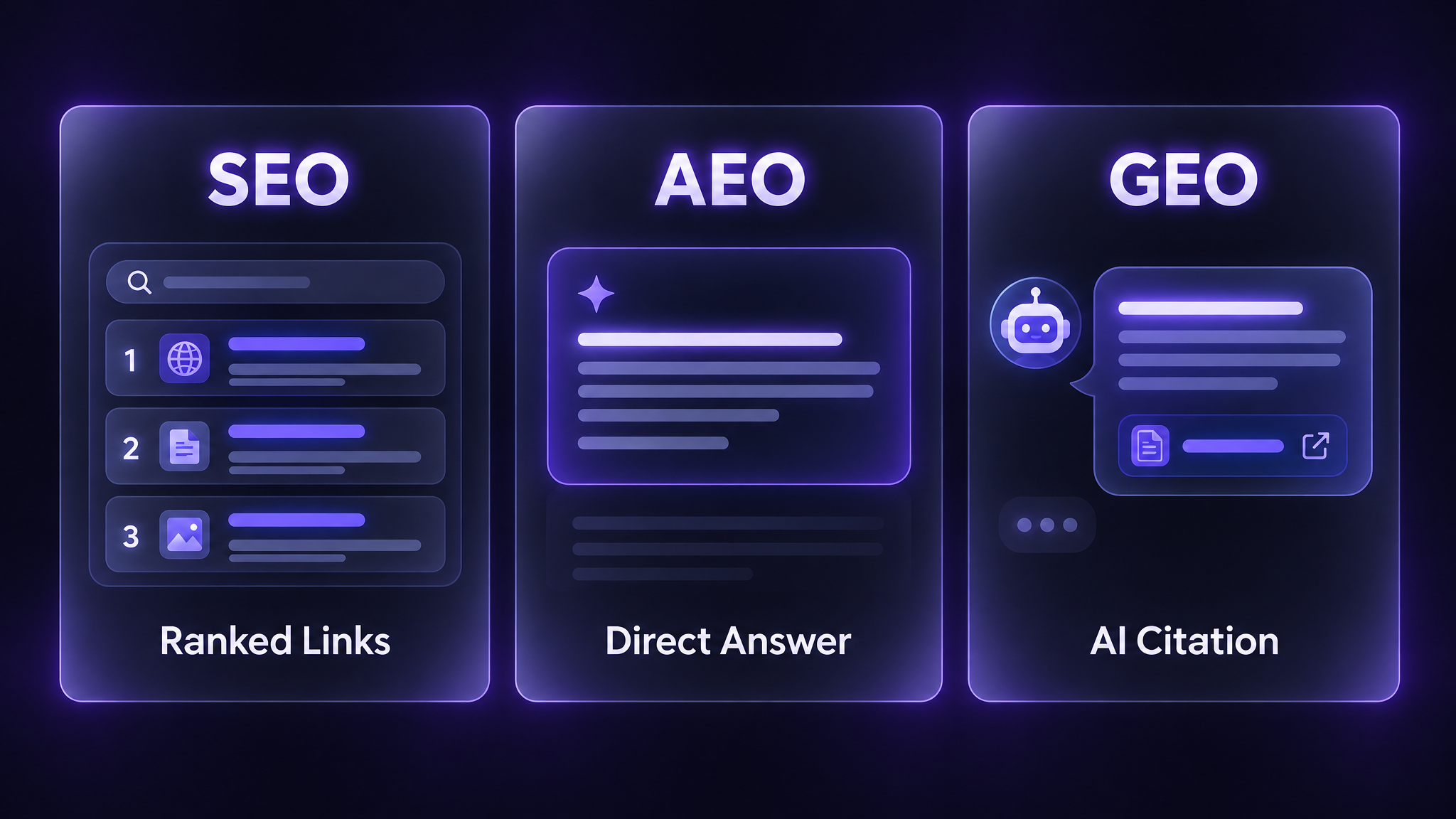
Each of those three behaviours has its own discipline: SEO for the ranked list, AEO for the direct answer, GEO for the AI recommendation. They overlap, they build on each other, and they are not interchangeable. Understanding the difference is the first step to spending your marketing budget in the right place.
SEO: the foundation everything else rests on
Search Engine Optimisation is the practice of making your website rank higher in Google's organic results — the blue links below the ads. It has been around since the late 1990s and it is still the highest-volume channel for most South African businesses.
SEO works on three levels. Technical SEO means your site loads fast, works on mobile, has no broken pages, and can be crawled and indexed by Google without errors. On-page SEO means each page targets a specific search query, uses that query in the right places, and answers the searcher's question better than the competing pages. Off-page SEO means other credible websites link to yours, which tells Google your site is worth trusting.
The payoff is compounding. A page that ranks on page one for a high-volume query keeps bringing in traffic month after month without you paying for each click. The cost is time: most South African businesses see meaningful ranking improvements after three to six months of consistent work, and the full benefit of a well-built SEO foundation takes twelve to eighteen months to show.
What SEO cannot do is win the direct-answer box or get your business recommended by ChatGPT. Those require different work — which is where AEO and GEO come in.
AEO: winning the direct answer
Answer Engine Optimisation is the practice of structuring your content so that search engines and AI assistants pull it as the direct answer to a question — the featured snippet at the top of Google, the voice search result, the AI Overview paragraph.
The searcher who triggers an AEO result has already decided what they want to know. They typed a full question — "how long does it take to rank on Google in South Africa?" — and they want a direct answer, not a list of pages to click through. If your page gives that answer clearly and concisely, Google may lift it into the answer box. The searcher gets their answer without clicking. You get the brand impression even without the visit.
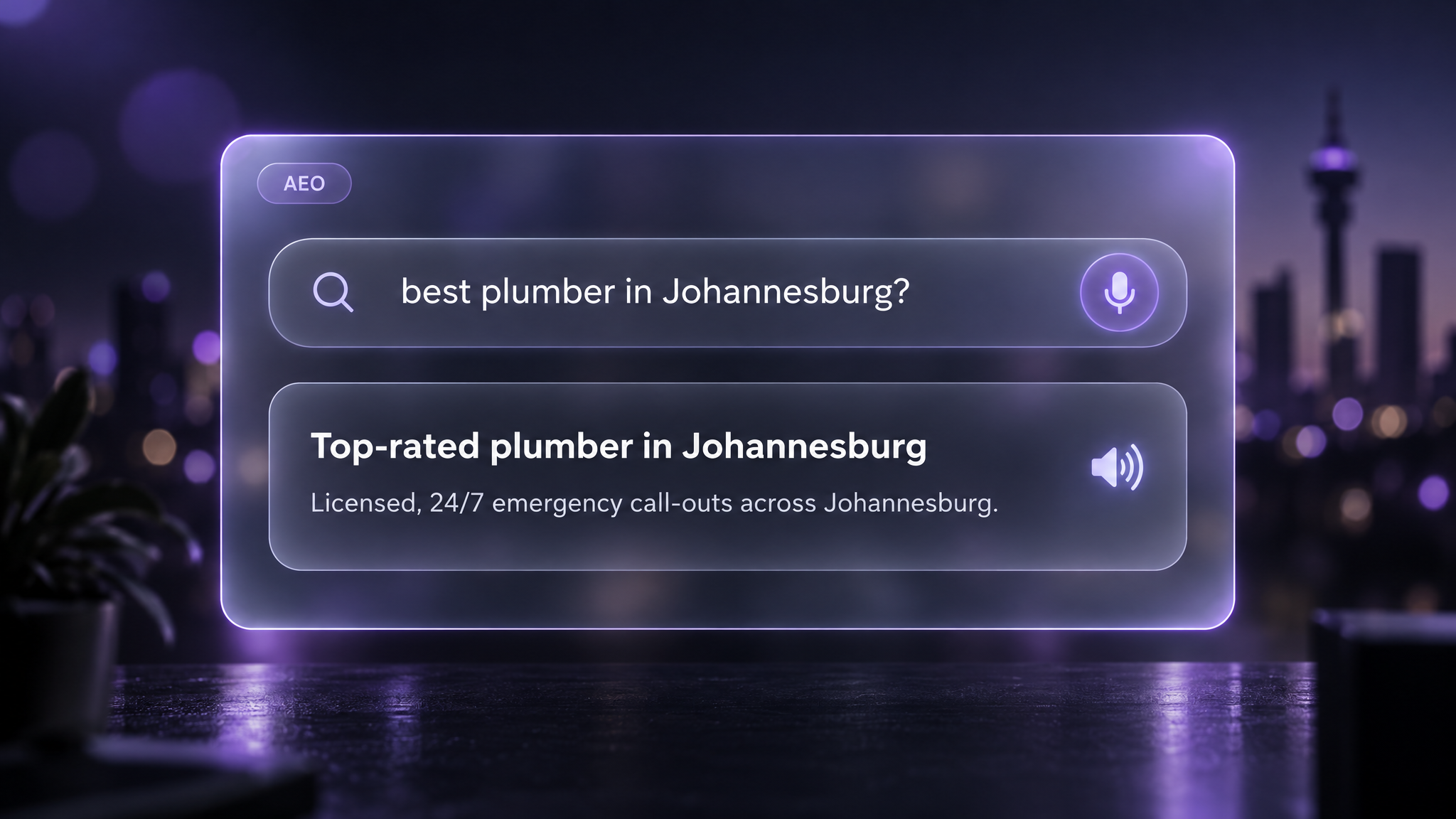
AEO is not a separate technical system. It is a writing discipline layered on top of SEO. The same page that ranks for a keyword can also win the featured snippet if it is structured correctly: a short, direct answer in the first paragraph under each heading, followed by supporting detail. FAQ sections with real customer questions written in plain language. Schema markup that tells Google exactly what type of content each section contains.
The practical implication for South African businesses: if you are already doing SEO, AEO is mostly about rewriting your existing pages to lead with the answer rather than building up to it. It is not a separate budget line — it is a content habit.
GEO: getting recommended by AI
Generative Engine Optimisation is the newest of the three and the least understood. It is the practice of getting your business named and cited inside AI-generated answers — when someone asks ChatGPT "who is the best SEO agency in Gauteng?" or asks Gemini "which plumber in Pretoria has the best reviews?", GEO is the work that determines whether your name comes back.
GEO differs from SEO and AEO in a fundamental way: there is no ranked list. The AI gives one answer, or a short list of two or three names. Either you are in it or you are not. And unlike a Google ranking, you cannot see where you stand without actively testing it — the AI does not publish a leaderboard.
What gets a business cited in AI answers? From what we see across client accounts and from the published research, four things matter most. First, consistency: your name, address, phone number and website must match across every directory, review platform and listing. AI engines build a picture of your business from dozens of sources; contradictions make them uncertain, and uncertain businesses do not get recommended. Second, reviews: real reviews that mention specific services and suburbs give the AI the language it needs to match your business to a specific question. Third, content that answers directly: pages that lead with a clear, specific answer to a real customer question get cited; pages that warm up for three paragraphs before saying anything do not. Fourth, third-party mentions: directory listings, industry body memberships, local press coverage, forum threads — the AI trusts sources that are not yours.
The overlap with SEO is real. A business with a strong SEO foundation — fast site, complete Google Business Profile, consistent citations, genuine reviews — is already most of the way to GEO readiness. The extra steps are an llms.txt file, FAQ-rich pages that answer directly, and presence on the specific sources AI engines pull from. There is a full breakdown in what is GEO and the evidence behind the tactics in what we actually know about GEO.
How the three relate to each other
| SEO | AEO | GEO | |
|---|---|---|---|
| Goal | Rank in a list of links | Win the direct answer box | Be named in an AI answer |
| Where it shows up | Google organic results | Featured snippets, AI Overviews, voice search | ChatGPT, Gemini, Perplexity, AI Overviews |
| Unit of success | Position 1–10 | The answer box or snippet | A citation or recommendation |
| Traffic type | Clicks to your site | Brand impression, sometimes a click | Often no click — direct action |
| Foundation needed | Technical site health | SEO + structured content | SEO + AEO + off-site consistency |
| Time to results | 3–12 months | 1–3 months once SEO is solid | 3–6 months once SEO + AEO are solid |
| Measurement | Rankings and organic traffic | Featured snippet share | Share of voice across tracked prompts |
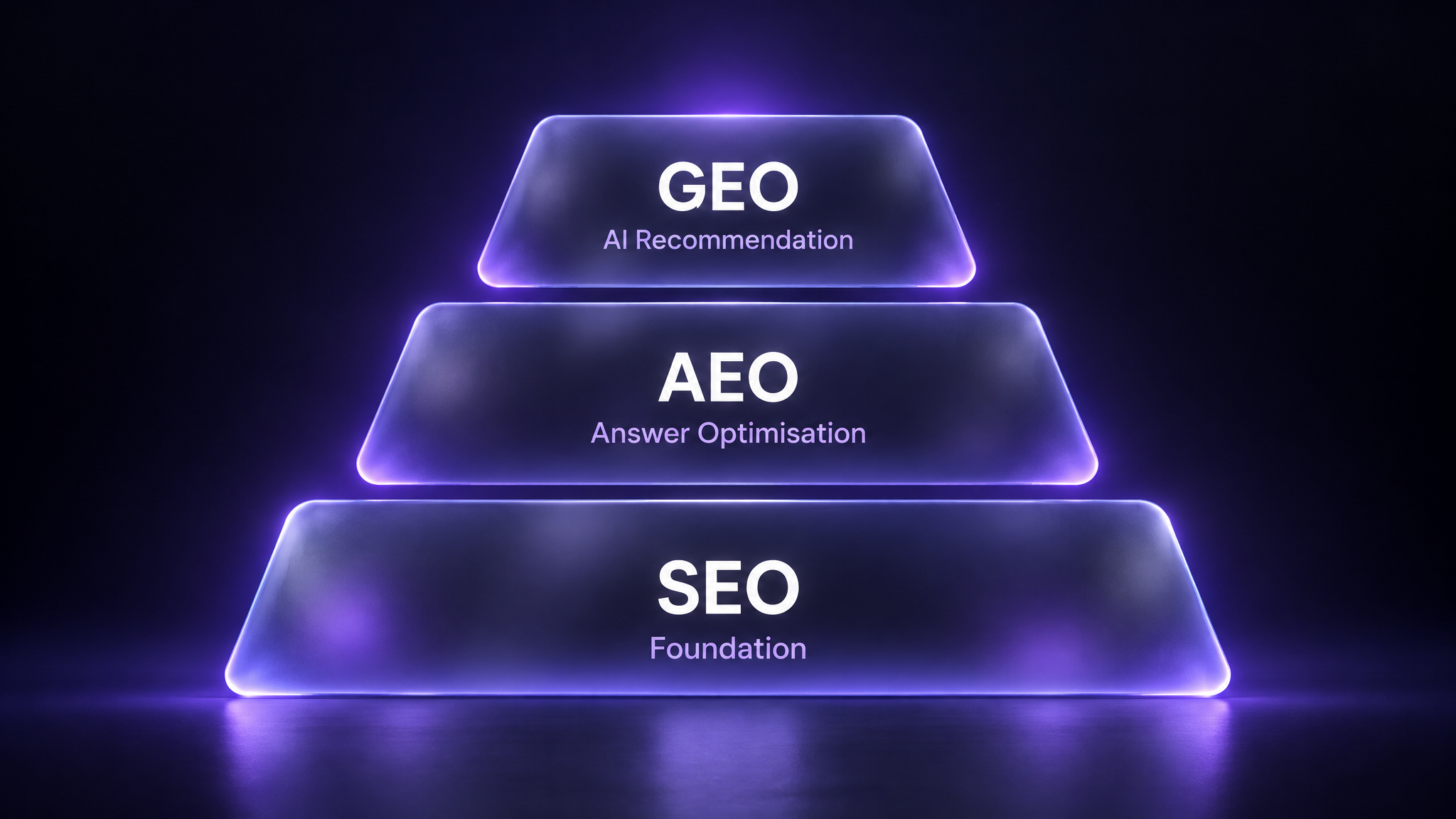
The table makes the dependency clear: AEO builds on SEO, and GEO builds on both. A business that skips SEO and goes straight to GEO is building on sand. The AI engines pull from the same signals Google does — a site that Google cannot crawl, a Google Business Profile that is incomplete, citations that contradict each other — these problems hurt GEO just as much as they hurt SEO.
Which one does your South African business need first?
The honest answer for most South African service businesses is: SEO first, then AEO, then GEO — in that order, not simultaneously.
Start with SEO if your website is not ranking for your core service keywords, your Google Business Profile is incomplete or inconsistent, your site loads slowly on mobile, or you have never done any structured keyword research. These are the foundations. Without them, AEO and GEO work is wasted.
Add AEO once your SEO foundation is solid. Rewrite your key service pages to lead with direct answers. Add FAQ sections with real customer questions. Implement FAQ schema. This work takes weeks, not months, and the payoff — featured snippets, AI Overview inclusions — can come quickly once the underlying page is already ranking.
Layer in GEO once AEO is in place. At this point the incremental work is relatively small: an llms.txt file, a few additional question-led pages, and a systematic review of which directories and third-party sources the AI engines in your industry are pulling from. The bigger ongoing commitment is tracking — running a fixed set of prompts across ChatGPT, Gemini and Perplexity monthly to measure your share of voice.
The South African context
South Africa has some specific characteristics that affect how you prioritise these three disciplines.
Google dominates here more than in most markets. Google holds over 94% of South African search referrals. That means SEO is not optional — it is the primary channel for almost every service business in the country. AEO matters because Google's AI Overviews are rolling out in South Africa and voice search is growing on mobile. GEO matters because ChatGPT and Gemini are real referrers, but they are still a small fraction of total search traffic.
The practical implication: do not let GEO excitement distract you from SEO fundamentals. A Gauteng plumber who ranks on page one for "emergency plumber Johannesburg" will get more leads from that one ranking than from being recommended by ChatGPT for the next twelve months. Do the SEO. Then do the AEO. Then do the GEO.
What makes the GEO opportunity real for South African businesses is that almost nobody is doing it yet. The businesses that build AI visibility now — while the competition is still ignoring it — will have a significant head start when AI referrals become a meaningful share of total traffic. That is not a reason to skip SEO. It is a reason to build all three, in order, starting now.
What this costs in South Africa
SEO in South Africa runs from R10,000/pm for a Starter local SEO package to R30,000/pm for a Scale package covering national SEO, content, Google Ads and AI visibility. The SEO cost guide covers what each tier includes and who it suits.
AEO is not a separate line item at BurnesSEO — it is built into every content and SEO engagement. The structured content, FAQ sections and schema markup that win featured snippets are part of how we write every page.
GEO is available as a standalone service for businesses that already have their SEO foundation in place, or as part of the Growth and Scale bundles. The GEO service page has the detail.
If you are not sure where you stand, two free tools give you a starting point. The AI Visibility Score shows how visible you are in AI search across twelve dimensions. The website audit shows the technical SEO gaps holding your site back. Both are genuinely free, no email wall.






Not sure which one your business needs first?
Run the free AI Visibility Score to see where you stand in AI search, or check your website audit to find the SEO gaps holding you back. If you want a human read, call or WhatsApp 079 100 5187 or email hello@burnesseo.co.za.