ChatGPT Ads in South Africa: should your business be advertising inside the chatbot?
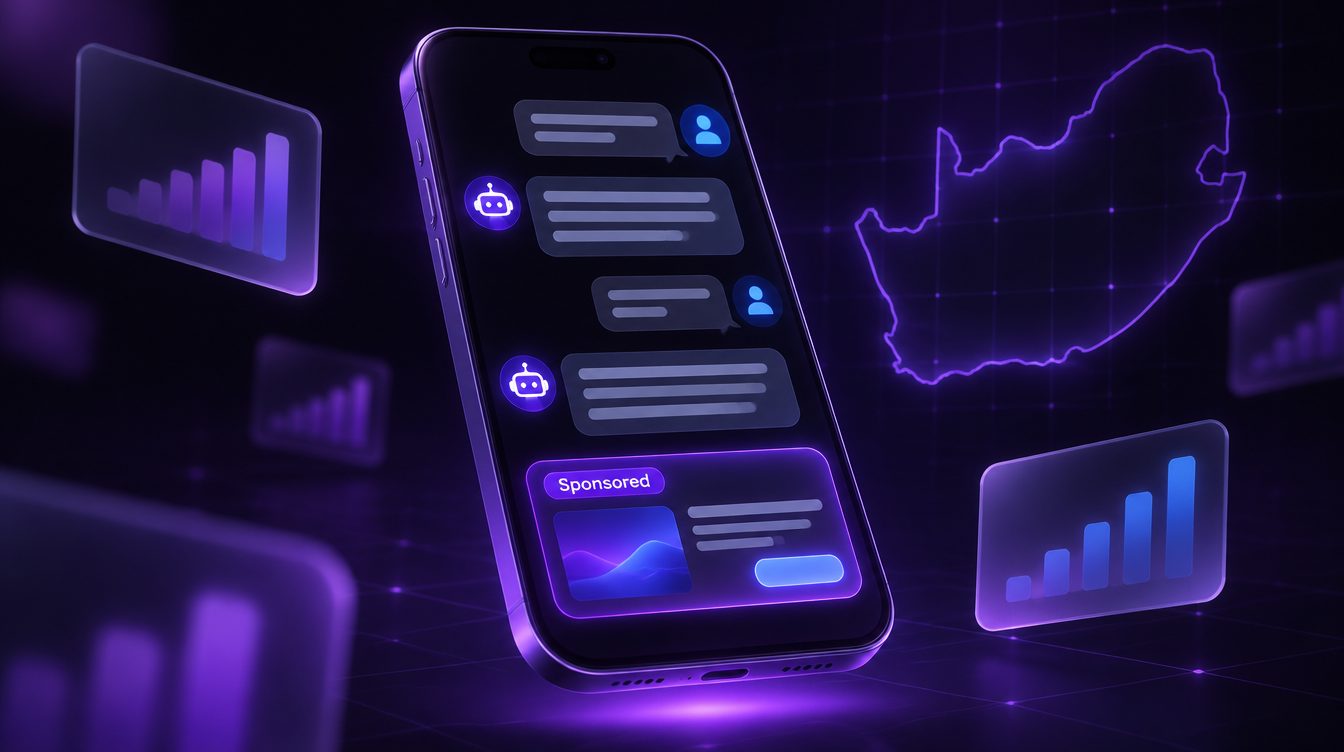
ChatGPT Ads switched on for South African businesses on 21 October 2026. Here is who it works for, what it costs in rand, why you need to be recommended before you pay to be seen, and how to run a first test without wasting the budget.
Published
What actually changed on 21 October 2026
OpenAI started testing ads in ChatGPT in the United States in February 2026. A self-serve Ads Manager followed in May, with no minimum spend and cost-per-click bidding. On 21 October the company expanded to 26 more countries, including South Africa and Nigeria, taking the total to 89. By then more than 100,000 advertisers had already run campaigns.
For a Gauteng plumber, a Pretoria attorney or an online retailer in Durban, that means a new paid channel with almost no local competition yet. Most South African agencies have not touched it. At the time of writing, only a handful have published anything on it at all.
Which AI is the biggest in South Africa, and does it matter?
It matters because you can only buy ads on one of them. Google Gemini does not sell ads inside its answers. Neither does Claude or Perplexity. ChatGPT is the only major assistant with a self-serve ad platform, and it happens to be the one South Africans use most.
| AI chatbot | SA traffic share (Jun 2026) |
|---|---|
| ChatGPT | 73.2% |
| Microsoft Copilot | 12.1% |
| Google Gemini | 7.0% |
| Perplexity | 4.5% |
| Claude | 3.2% |
On mobile the gap is wider still: ChatGPT holds about 89% of South African mobile chatbot traffic.
Two things to keep in perspective. First, AI chatbots are still a sliver of total referral traffic in South Africa, well under 1% against Google Search. Nobody should move their Google Ads budget into ChatGPT. Second, the ChatGPT user base skews towards the free tier, which is exactly where the ads appear. Only around 5% of users pay, so the ad-eligible audience is most of it.
How ChatGPT Ads work (and what they can’t do)
An ad is a labelled “Sponsored” card that appears below the AI’s answer. It is matched to the conversation’s context, not to a keyword. Someone asking “which Gauteng attorney handles labour disputes for small businesses” is a much richer signal than the two-word Google query “labour lawyer”.
What ads cannot do is change the answer. OpenAI keeps the ad system separate from the model. ChatGPT will still recommend whoever it would have recommended. Your ad sits underneath that recommendation. If the recommendation is your competitor, you are paying to be the second thought.
| Feature | Google Ads | ChatGPT Ads |
|---|---|---|
| Targeting signal | Keyword + intent + location | Conversation context + country |
| Who sees it | Everyone searching | Free and Go plan users only |
| Minimum spend | None | ~$25 (≈R450) per campaign per day |
| Bidding | CPC, CPA, ROAS, etc. | CPC, CPM, conversion-optimised |
| Measurement | Mature; GA4, offline conversions | OpenAI pixel + Conversions API; still maturing |
| Local search / Map Pack | Yes | No |
| Restricted sectors | Normal policy | Finance, health and legal ads limited to the US for now |
| Competition in SA | Heavy | Almost none (Nov 2026) |
The restriction above matters for our clients. If you are an attorney, a medical practice or a financial adviser in South Africa, you cannot run ChatGPT Ads yet. For you, the only route into ChatGPT is organic: being the business the AI recommends — see our GEO service.
Why getting recommended comes before getting advertised
This is the part most “we now offer ChatGPT Ads” announcements skip. When a prospect asks ChatGPT for a recommendation, the model draws on what it can find and verify about businesses in that category: a consistent name, address and phone number across the web, structured data on the website, real reviews, press mentions, and clear pages that answer the questions people actually ask.
That work is called Generative Engine Optimisation (GEO). It is the same foundation that wins the Google Map Pack, which is why we treat it as one job. A business that already shows up organically in ChatGPT’s answer gets two placements for the price of one ad: the recommendation and the Sponsored card. A business that does not gets one placement and a credibility gap.
Who should test ChatGPT Ads in South Africa now
Good fit:
- Online retailers with a clean product feed, instant EFT or PayShap at checkout, and a delivery promise that holds up against Takealot. Black Friday on 27 November is the obvious first test window.
- Software, tools and subscriptions. Software made up about a third of early ChatGPT ad placements in one analysis of 66,000 ads. People describe their problem in full, which suits a product with a clear use case.
- High-ticket home and business services where the buyer researches before calling: pool covers, solar installers, event companies, corporate gifting, security.
- Any business already being recommended by ChatGPT. Check first. Ask ChatGPT for a recommendation in your category and city and see if you appear.
Not yet:
- Attorneys, medical and dental practices, financial advisers: restricted outside the US.
- Businesses with a website that cannot convert a stranger arriving mid-decision. Fix the site first.
- Anyone whose Google Ads account is not yet profitable. Prove the easier channel before testing the harder one.
What a sensible first test looks like
- Run a GEO baseline. Entity cleanup, schema, Google Business Profile, review generation, and three to five pages that answer your buyers’ real questions. Six to eight weeks.
- Install measurement before spending. OpenAI pixel plus server-side Conversions API, tied into GA4 with its own channel grouping. Some early advertisers reported clicks their analytics could not find. Do not be one of them.
- Cap the budget. R450 a day minimum, so around R13,500 a month for one campaign. Set it as new money, not money taken from a Google campaign that already works.
- Write for a conversation, not a keyword. The ad shows after someone has described their situation. Headlines that answer the described problem outperform brand slogans.
- Judge it at 60 days on cost per qualified lead, side by side with Google. Keep it if it holds up. Pause it if it does not. Either way you will know, and your competitors will not.
What it costs
OpenAI’s own charge is the media spend: from about R450 a day per campaign, billed in US dollars. Management is separate: R3,500 once-off setup, then a flat R5,000 a month including your monthly performance report. Ad spend is always billed directly to you by OpenAI with no markup.
Compare that with the alternative of doing nothing. The paid channel has been open in South Africa for less than a month, and very few local advertisers are in it yet. The cost of an early, measured test is small. The cost of learning this channel in 2028, when every competitor is already in it, is not.
See the full pricing and service detail on the ChatGPT Ads service page.
Sources
- OpenAI, “ChatGPT Ads expands to 26 new countries”, 21 Oct 2026
- OpenAI, “New ways to buy ChatGPT ads”, May 2026
- Bizcommunity / TDMC, “ChatGPT ads are live in SA”, 30 Oct 2026
- Bizcommunity / 365 Digital, “ChatGPT Ads in South Africa: how Criteo helps brands reach shoppers”, Nov 2026
- Statcounter Global Stats, AI chatbot market share, South Africa, May–Jun 2026
- Reuters / OpenAI, ChatGPT weekly active users, Feb 2026
- Memeburn, “ChatGPT ads trigger a new software marketing race”, 2026




Want us to run it for you?
BurnesSEO manages ChatGPT Ads alongside Google Ads for South African businesses, with the GEO groundwork built in so you are recommended before you are sponsored. Published pricing, month to month, no lock-in. See the [ChatGPT Ads service](/services/chatgpt-ads) or [check if ChatGPT recommends you](/tools/ai-visibility-score).